Treatment Comparison
Ultherapy vs Thermage
Which Non-Surgical Lifting Treatment Is Right for You?
Both treatments lift and tighten without surgery. The difference is how deep they work — and which concerns they address best.
Treatment Overview
Two Gold Standards, Different Approaches
If you're researching non-surgical skin tightening in Sydney, you'll almost certainly encounter two names: Ultherapy and Thermage FLX. Both are FDA-approved, TGA-approved, zero-downtime, single-session treatments. Neither requires incisions or anaesthesia. Both stimulate your body's own collagen to produce natural, progressive improvement over 2–3 months.
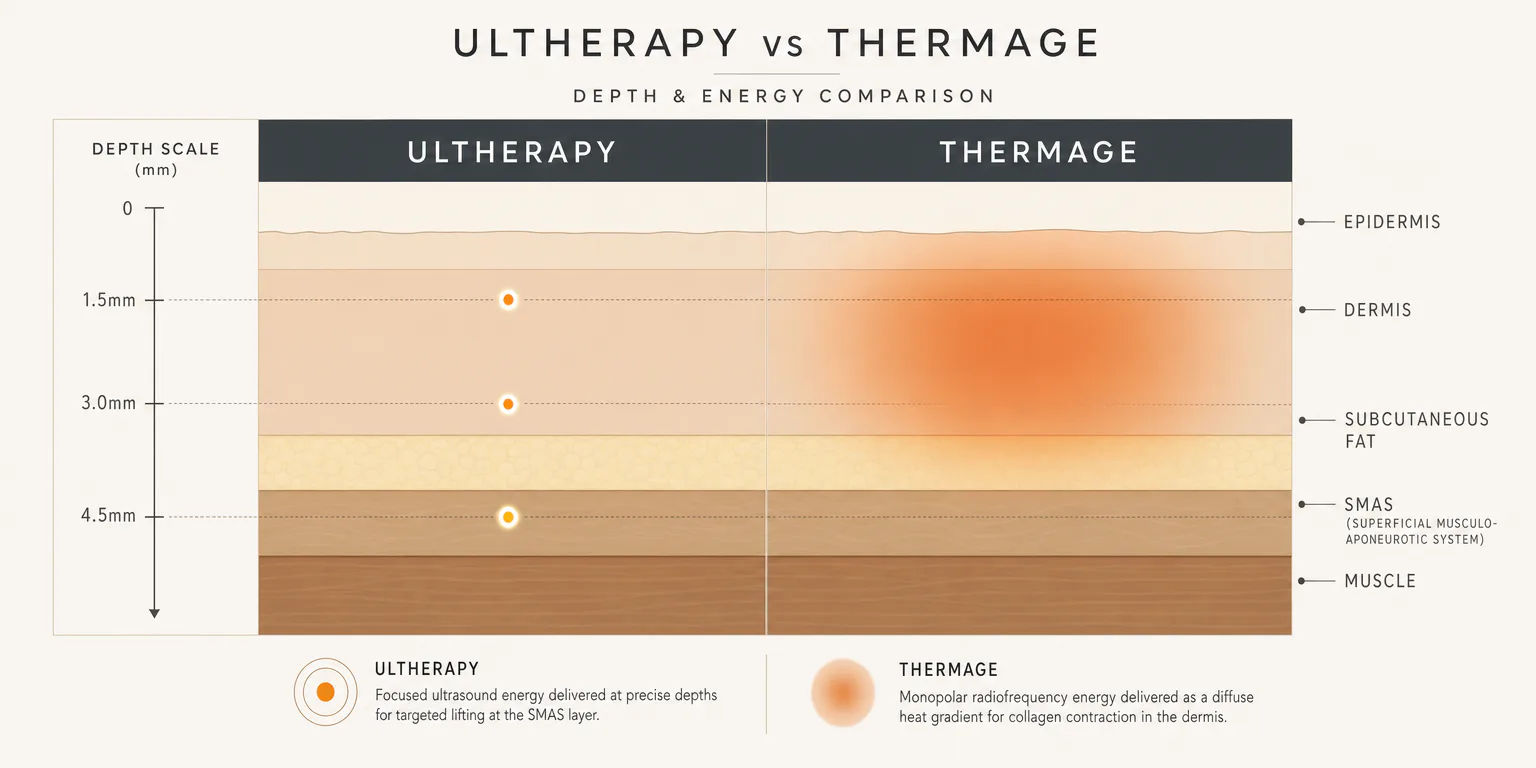
The critical difference is the energy modality. Ultherapy uses micro-focused ultrasound — the same imaging technology found in obstetric and cardiac ultrasound — to deliver heat precisely to depths of 1.5mm, 3.0mm, and 4.5mm. Thermage uses monopolar radiofrequency (RF) to volumetrically heat the deep dermis and subcutaneous tissue, with an integrated cooling system to protect the skin surface on each pulse.
At 99 Medispa, we offer both — and we're one of very few clinics in Sydney CBD with this combination on-site. That means your practitioner can assess your skin, discuss your goals, and recommend the treatment (or combination) that best matches your anatomy and concerns — rather than pushing the one device they happen to own.
Ultrasound Lifting
How Ultherapy Works
Ultherapy combines real-time ultrasound imaging with microfocused ultrasound energy delivered at selected tissue depths to initiate collagen remodelling.
The three depths — 1.5mm (superficial dermis), 3.0mm (deep dermis), and 4.5mm (SMAS layer) — allow the practitioner to address different concerns in a single session. The 4.5mm depth is the defining advantage of Ultherapy: no other non-invasive treatment reaches this structural layer, which is the same layer lifted in a surgical facelift.
The focused heat (60–70°C) triggers neocollagenesis — your body breaks down old, damaged collagen fibres and replaces them with new, stronger ones. The lifting effect builds gradually over 2–3 months and typically lasts 1–2 years.
Best for: Visible sagging, jowls, brow lift, neck laxity, patients wanting the deepest non-surgical lift available.
Radiofrequency Tightening
How Thermage FLX Works
Thermage FLX delivers monopolar radiofrequency energy with precise heating for the non-invasive treatment of wrinkles and selected skin-tightening concerns.
The integrated Cryo cooling system chills the skin surface before, during, and after each RF pulse, protecting the epidermis while energy penetrates deeper. This makes the treatment comfortable enough for patients to tolerate full-face sessions without topical anaesthetic, and allows treatment of larger areas including the body (abdomen, thighs, arms).
The immediate thermal effect causes instantaneous collagen contraction — some patients notice subtle tightening right away. Remodelling continues over 2–6 months as new collagen forms, with results lasting 12–18 months.
Best for: General skin laxity, texture improvement, crepiness, fine lines, broader-area treatment (including body), patients wanting strong tightening with broad coverage.
Direct Comparison
Ultherapy vs Thermage: At a Glance
| Feature | Ultherapy | Thermage FLX |
|---|---|---|
| Energy type | Micro-focused ultrasound | Monopolar radiofrequency |
| Max depth | 4.5mm (SMAS layer) | ~4.3mm (deep dermis + fibrous septae) |
| Real-time imaging | Yes (DepthSEE ultrasound visualisation) | No |
| Treatment time | 30–90 minutes | 45–90 minutes |
| Sessions needed | Typically 1 | Typically 1 |
| Results visible | 2–3 months (progressive) | Immediate subtle tightening, full at 2–6 months |
| Duration of results | 1–2 years | 12–18 months |
| Downtime | None | None |
| Treatment areas | Face, neck, decolletage (brow lift FDA-cleared) | Face, eyes, body (abdomen, thighs, arms) |
| Discomfort level | Moderate (warmth, brief tingling) | Mild–moderate (heat with cooling bursts) |
| Body treatment | Limited (decolletage only) | Yes — full body capability |
| Pricing basis | Per transducer (line count) | Per tip (600 or 900 shots) |
How Deep Each Treatment Reaches
Treatment Depth, Side by Side
The clearest way to understand the difference is to see where each treatment delivers its energy. Ultherapy places focused ultrasound at three precise depths — reaching the SMAS at 4.5mm — while Thermage heats the dermis more broadly.
Decision Guide
Which Treatment Is Right for You?
The best choice depends on your specific concerns, anatomy, and tolerance. Here's a practical guide:
Choose Ultherapy If:
- Your primary concern is visible sagging, jowls, or a dropped brow line
- You want the deepest non-surgical lift available (4.5mm SMAS layer)
- You're interested in the FDA-cleared non-surgical brow lift
- You value real-time ultrasound imaging so your practitioner can see tissue layers before firing
- You have moderate skin laxity and want a noticeable structural improvement
- You're comfortable with a slightly higher sensation level for a stronger lift
Choose Thermage If:
- Your concern is general skin laxity, crepiness, or texture rather than deep sagging
- You want to treat a broad area (including body areas like abdomen or thighs)
- You prefer a treatment with integrated cooling for added comfort
- You want some visible tightening on the day of treatment (instantaneous contraction)
- You're treating delicate areas like the upper eyelids or fine lines around the eyes
- You're looking at a first-time treatment and want a gentler entry point
The combination approach: Many of our patients choose both treatments — Thermage for broad-spectrum tightening and surface texture, followed by Ultherapy for deep structural lifting. Spaced a few weeks apart, this protocol delivers comprehensive rejuvenation that neither treatment achieves alone. At 99 Medispa, we have both devices in our Sydney CBD clinic, so you can access the combination without visiting multiple clinics.
Common Questions
Frequently Asked Questions
Ultherapy uses focused ultrasound energy to target deep structural layers of the skin (down to 4.5mm), including the SMAS layer — the same layer addressed in surgical facelifts. Thermage uses monopolar radiofrequency (RF) energy to heat deeper layers of the dermis and stimulate collagen, with a focus on surface tightening and skin texture improvement. Both are FDA-approved, non-invasive, and zero-downtime, but their mechanisms of action differ.
Ultherapy is generally considered the stronger lifting treatment because it reaches the SMAS layer at 4.5mm depth, making it ideal for more significant jowling, brow descent, or neck laxity. Thermage excels at skin tightening, texture improvement, and subtle contouring — it produces a smoother, more toned appearance rather than a pronounced lift.
Both treatments produce a warm, sometimes prickly sensation as energy is delivered. Ultherapy patients often report a deeper warmth or brief tingling when the ultrasound applicator fires — the newer Ultherapy with Prime technology (using DepthSEE) reduces discomfort considerably. Thermage patients feel pulses of RF heat with cooling bursts between each pulse. Our practitioners adjust intensity to your tolerance and can pause at any time.
Both treatments stimulate your body's natural collagen production, so results continue improving for 2–3 months after a single session. Ultherapy results typically last 1–2 years, while Thermage results last 12–18 months. Maintenance treatments once a year help sustain the effect as natural ageing continues.
Yes — combining both treatments is one of the most popular approaches at 99 Medispa. Because they work at different depths through different mechanisms, they complement each other beautifully. Thermage addresses superficial tightening and texture, while Ultherapy lifts from the structural layer beneath. We typically recommend spacing them a few weeks apart.
Most patients achieve their desired result from a single session of either treatment. Some patients with more significant skin laxity may benefit from a second Ultherapy session 3–6 months later, or an annual Thermage touch-up. Your practitioner will assess your skin during a consultation to create the ideal treatment plan.
If your primary concern is visible sagging, jowls, or brows that have dropped, Ultherapy tends to be the better starting point because of its deeper reach. If your concern is more about general skin laxity, crepiness, texture, or mild sagging across a broader area (including body), Thermage offers broader coverage with a strong tightening effect.
Both are zero-downtime treatments. You can return to work or daily activities immediately. Some patients experience mild redness that fades within hours. Rare, temporary tenderness or slight swelling may occur with Ultherapy and normally resolves within a few days.
Pricing depends on the treatment area(s) and the number of lines/shots required. Ultherapy is priced per transducer line-count, while Thermage is priced per tip (600 or 900 shots). We offer both treatments at our Sydney CBD clinic at 99 York St. Book a free consultation for personalised pricing based on your specific concerns.
Both treatments are FDA-approved and TGA-approved with decades of clinical data. Over a million Ultherapy treatments have been performed worldwide. Ultrasound energy has been used in medicine for over 50 years, and monopolar RF technology (Thermage) has been used for over 20 years with an excellent safety profile.
Testimonials
What Our Clients Say
 Google Reviews
Take the Next Step
Not Sure Which Treatment Is Right?
Book a consultation to compare Ultherapy and Thermage against your skin, concerns and goals.
Complimentary consultation. No deposit required.
Follow Our Journey
Join our community on Instagram for treatment insights, showcases and current offers.
Booking
Choose a time that suits you
The booking form shows the selected service and available appointment times. Choose a date and time, then follow the prompts to finish.
Questions before booking?
Online booking is loading. If it does not appear, contact our team.